Unlike regular HTML, buttons are
more than just simple navigation interfaces. In Flash, any
object can be a button. Buttons not only provide feasible
methods of taking the user to another page, but buttons also
create an interface where certain advanced functions can be
called. In the tutorial below, you will learn how to create
a button and add the over, down, and hit states.
The animation below will show
how your button will look at the end of this tutorial. (Move
the mouse over the circle and click to see what I am talking
about):
Creating And Making The
Button Work:
First, create a new movie in
Flash. This is fairly a simple procedure, so there will be
no "intro" source code. There is the link to download the
final source code on the bottom of this page as usual.
Here's How:
Once you have opened a new
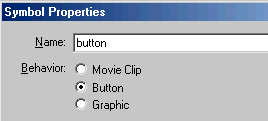
Flash document, go to Insert > New Symbol. From the window
that pops up, pick the option for Button and give it a
name that will be easy to remember. Click OK. See image
below:
Once you have
done that, you should see that your timeline has now
changed to accommodate the properties of buttons. For this
example, click on the Frame marked "Up", and draw a Circle
in the drawing area. Also, right click on the other frames
marked "Over", "Down", and "Hit" and choose Insert
Keyframe. You may want to change the color of the circle
for the Over and Down states so you can see that the
button works. This will resemble the color changes in my
example at the top of this page.
Now, all you have to do is add the movie to your main
timeline. Remember that this button was inserted as a new
symbol, and must be placed in the main movie to work.
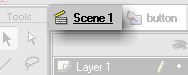
Click on the Scene 1 button on the top left to be taken to
the main movie. See image below:
If you started this button from a new movie,
your timeline and drawing area should look empty. To add
the button, click on Window > Library (or Ctrl + L on
keyboard) to launch the Library Window. Now all you have
to do, is drag the instance "button" from the
library to the timeline. Just a simple click and drag!
Your timeline should have one and only one Keyframe on
the first layer. The button should also be visible while
on the screen. You can test to see how the button works by
pressing Ctrl + Enter or by going to File > Publish
Preview > HTML.
Just a final word before we wrap up. If you have a question and/or want to be part of a friendly, collaborative community of over 220k other developers like yourself, post on the forums for a quick response!



 Adding
A Button
Adding
A Button