Tutorials
Books
Videos
Forums
Tutorials
Books
Videos
Forums


This is an archived tutorial from the kirupa.com legacy collection. It covers software that may no longer be available, but it is kept online because the ideas still hold up.
A much hyped about feature of Flash MX 2004 is the timeline effects. Timeline effects are a collection of special effects that you can customize and apply to an object on your stage such as a movie clip, graphic, etc. If you have ever used programs such as Wildform's Wild fx or Red Giant Software's Text FX, you have seen how you can easily add custom text effects with a few simple clicks. Flash MX 2004's timeline effects work similarly, but the effects are not limited only to text. You can apply the timeline effect to any object.
The following animation provides an example of four types of timeline effects that come with Flash MX 2004. Click each of the text options such as "Blur", "Drop Shadow", etc. in the following animation to see the various special effects:
[ click on the above text buttons to see the special effects ]
This tutorial will briefly explain how to apply all of the timeline effects. Grab a box of pop-corn and get ready. This tutorial is about to start!

[ the circle you drew ]
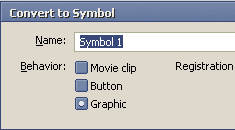
[ select Graphic and press OK]
 |
Note |
|
You may remember that in step iii, I
told you to convert your circle into a graphic
object. The timeline effect will work for any object
- even ones freshly drawn with no symbolic
association. The only issue is that the Expand
effect does not work unless what you have on stage
is converted into an object.
You can also apply the effects to movie clips that contain their own series of motion tweens, etc. For the sake of simplicity, I am using a plain, filled circle. |
|
The first effect I will explain is the Blur effect. Select your circle graphic and go to Insert | Timeline Effects | Effects | Blur. The Blur editor window should appear. You should see a small animation of your circle blurring in and out on the right with options on how to customize the effect:
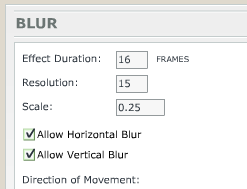
[ the blur effect editor ]
I am sure you would like to know what each of the options actually explain:
Specifies the number of frames for which the blur effect will continue. For a quick blur, enter a smaller number. For a longer blur, enter a larger number.
Specifies the number of individual copies of your object that will be used to create the blur effect. The blur effect basically copies your object and scales it while fading out at the same time. The higher your number, the more objects will be scaled and faded out within the duration you specified.
Specifies the scale of each copy of your object that is made to simulate the blur effect.
Specifies whether you want the blur to occur in only one direction. Notice that by checking or unchecking these boxes, you can adjust the direction with which the blur effect goes in.
The 9 arrows (not displayed in the above image) further help define your blur effect's direction of movement:
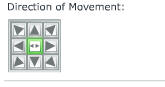
When you check both the boxes for Allow Horizontal Blur and Allow Vertical Blur, the effect is oriented toward the center as shown by the green border surrounding the center square. If you press any of the buttons such as the one for Top Right, you will find your animation seems to shift the blur to the top right direction.
You should note that if you only check the Allow Vertical Blur, you will only be able to adjust the direction movement in the vertical likewise. The opposite is true if you only check the Allow Horizontal Blur check box. You will only be able to, in that case, to adjust the blur horizontally.
You can press Update Preview to see how your effect looks now. To finalize your effect, press OK and preview your animation by pressing Ctrl + Enter or previewing the animation in your browser.
Save this file as something else because it would be best not to overwrite the original timeline effects fla you created earlier. We will use that file for the three other timeline effects.
Let's proceed to the next section to learn about a few more interesting effects.
Continuing from the previous section, there are several more types of timeline effects that we haven't explored yet. The second effect is the Shadow effect.
Open your timeline effects file that you created earlier. This movie should contain no effects or anything. It should only contain your circle graphic. Select your circle graphic and go to Insert | Timeline Effects | Effects | Drop Shadow.
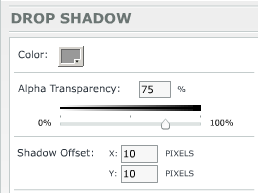
[ the drop shadow effect editor ]
The following list explains what each option accomplishes:
This should be pretty straight-forward. Here you get to specify what color your shadow will be. Clicking on the color square will display a lot more colors for you to pick and choose from.
This setting specifies the transparency of your shadow. A really high number makes your shadow very opaque - not transparent at all. A low number makes your shadow very transparent.
When you look at your shadow in the preview area on your
right, you will notice that your shadow is located a few
pixels below and to the right of your original graphic. In
the X: and Y: boxes, you get specify exactly the number of
pixels your shadow will be from its source - the original
circle graphic.
You aren't limited only to positive values btw. You can
enter negative numbers to make your shadow go to the top,
top-left, or left of your original circle graphic.
As always, you can press your Update Preview button to get an up-to-date preview of how your shadow looks like with the settings you have input. Save this animation as drop shadow and open your original timeline effects you created in the previous section. Time for our next effect.
Open your timeline effects file that you created earlier (if you haven't opened it already). This movie should contain no effects or anything. It should only contain your circle graphic. Select your circle graphic and go to Insert | Timeline Effects | Effects | Expand:
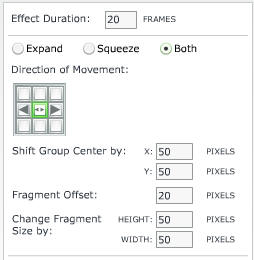
This effect's customizations are a little bit complicated, but the effect can still be pretty cool! The following list explains how to customize this animation:
The last setting - Change Fragment Size - is probably the most important setting of this effect. If you were to ignore all of the other options and focus all of your resources on this setting, your effect would almost be complete. The above settings are just the frosting for the cake.
Save this file as expand effect and fasten your seatbelts for the Explode Effect.
By now, I am sure you know that I am going to tell you to open the timeline effects file again. So make sure to have saved your previous file for the expand effect and re-open your timeline effects fla that you saved earlier. Select your un-effected circle graphic and go to Insert | Timeline Effects | Effects | Explode:
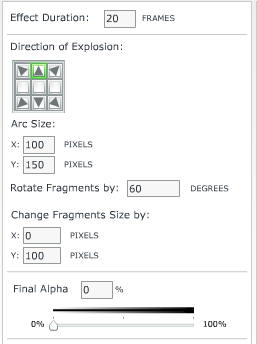
The explode effect is pretty cool. The settings for the explode effect are as follows:
This setting specifies the number of frames your effect will run for. A larger number will result in a dragged out, longer explosion. A smaller number will result in a quick explosion.
This setting specifies the direction in which the fragments of your explosion will travel in.
Your fragments' trajectory is curved. You can specify the various details of your curve from this setting.
This setting specifies by how many degrees the individual particles of your explosion will rotate.
You can have your fragments expand or contract. The numbers you enter here will decide whether that happens or not!
This setting will specify what the final transparency of your fragments will be. A value of 0 will ensure your fragments fade out.
|
|
Removing or Editing Effects After Applying the Effect |
|
Modifying an Effect
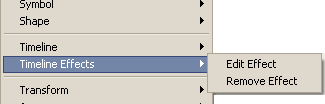
To modify an effect you applied, select the object to which you applied the effect to and go to Modify | Timeline Effects | Modify Effect. Removing an EffectTo remove an effect you applied, select the object to which you applied the effect to and go to Modify | Timeline Effects | Remove Effect. The obligatory screenshot:
[ the 'edit effect' and 'remove effect' menu items ] You should also note that once you apply an effect to an object, you can't remove or edit the special effect if you were to manually edit the object by double clicking on it, editing in place, etc. Flash should prompt you when you try to manually edit the object. If not, consider this paragraph your warning =) |
|
Well that concludes this tutorial about the timeline effects. These effects are pretty cool for the casual designer interested in adding some extra life to your animation. You can download the FLA of the animation you saw on the first page:
 |
Just a final word before we wrap up. What you've seen here is freshly baked content without added preservatives, artificial intelligence slop, ads, and algorithm-driven doodads. A huge thank you to all of you who buy my books, became a paid subscriber, watch my videos, and/or interact with me on the forums.
Your support keeps this site going! 😇


:: Copyright KIRUPA 2026 //--