 Tutorials
Books
Videos
Forums
Tutorials
Books
Videos
Forums


What are you trying to do? If you can answer that question, you're ready to begin! I cannot express to you enough, that from the beginning to the end of your project, you MUST have an idea of what your outcome is going to be. Even if it's something simple like: "Make a cool game that people will want to play", is something, not very well thought-out, but it's a start. ideally, you should have a general idea of what you want to finish with. For me, I wanted to create an Old-School Style RPG, which shifts the focus back on game play, and story, and away from Graphics. You can be more, or less elaborate if you want. You don't have to put this to paper, or anything, just keep it in mind as you work on your story.
There you have it! That's your foundation! Not very much yet, I know, but you're getting there!
Next Section - Part 2: The Setting
Now that you have a general idea of the type of game your looking for, now you need to come up with a setting for your story. The setting is basically the overall stage for your game. Some games benefit from completely original, and alien landscapes, while other games seem to make sense in settings that are familiar, and common. It all depends on your overall theme, the one you came up with before. If your making a post-apocalyptic game, you may want to have your game take place in an unrecognizable wasteland, or smack-dab in the middle of Chicago. Most RPG's, with a fantasy setting take place on a foreign world, almost completely different from our own (Example: Final Fantasy, Chrono Trigger, Star Ocean) Platform games tend to use either a setting that is bizarre, almost humorous (Example Mario, Earthworm Jim), or a 'generic' setting that is easy to compare to something the player knows (Double Dragon, Ninja Gaiden). This should be something simple to come up with, don't spend to much time fretting on the basic Setting, you have to save your energy for what's coming up. My job was a little harder, since in Worlds, the player moves from world to world, in which each setting is different. I made my setting encompass the entire Omniverse, so effectively, my setting is as follows: Worlds takes place in an Omniverse, composed of infinite separate universes (or universi?) similar to cells in a body, separated by a substance called "Ether". Travel between universe(es/i) is difficult to accomplish, but possible.
Once you have this put down to paper, you should be ready (and hopefully excited) to elaborate on it. You should start thinking about the details of your setting, and how they all interact. This is where the hard work comes in. Break out those pencils people! Now you have to build your setting into a believable, and hopefully enjoyable environment for the PCs (Player Characters) to romp through. This is one of the difficult parts of Story Development. You have to make everything in your setting mesh smoothly together, nothing should contradict each other. For instance, if your setting says that in the ancient past, humans could wield all kinds of magic, that is now lost to today's generation, then compliment, and talk about this aspect of history by having Modern Mages talk about that era, and show artifacts, and other relics of the past era: magnificent castles, powered by ancient magic still working, or giant crater-scarred plain where ancient battles occurred. However, you need to think about what this would mean to the currently living population: Do they now have an abundance of ancient magical items that still work? Is magic now extremely rare/non-existent? What happened to that race of Mages? Did they kill themselves? Did thy inter-marry with non-magical folk, and 'water down' the gene pool? Whatever you pick should be consistent with your setting: Don't choose to eliminate magic all together, and then decide you want your PCs to have powerful magic skills - unless you can explain it. Explaining things away can be easy, but be careful - make sure it makes sense, and don't just say: "they can do this, that no one else can do, 'cause they are cool/powerful/special!" - that's a cop-out, and is just sad. In following my example, you could say that they were gifted by some kind of magical artifact, or perhaps there is a fringe race of people who still have magical abilities, or something more sinister is going on... try to avoid the easy way out. It's always better, and sometimes more fun, to make something up that's interesting, than copping out.
The setting is one of the hardest, most rewarding, and most fun of all the aspects of Story Development, at least to me. I want to note, that at this point we're not making up individual locations, just a general world/area-wide collection of information about how things work, how they are, and their history. One method I've come up with to put everything in order, is to make sort of a list of things involved with the setting... I mostly use this list for my personal use, until I'm ready to publish to my Design Document. Here's an example excerpt on the subject of 'Ether':
Ether:
Has metallic Blue/Violet sheen
disappears quickly while in Material environment - looks like quicksilver floating away and shrinking....
has morphological effects on material organisms immersed in ether for extended periods of time.
I have pages, and pages of similar writing, which I reference when needed. Some of it has ended up in a final form in my Design Doc (lit. Really Big File Full of Really Important Stuff). Feel free to spend as much, or as little time in this section as needed to flesh out your environment, and don't think that once you've made up as much cool stuff as possible that you're done, you should come back to this section often to add things, remove things, and make changes to make sure everything is kosher. Okay, so now we have our Destination Goal laid out for us, and a basic idea of the type of game it's going to be, plus, we now have a detailed chunk of paper full of information about our environment. We're getting there!
This is where the fun really starts.
By Definition: A Player Character (or PC) is any character in your game that the person playing the game has control over. Depending on your game genre, you might have a whole lot of PCs, or just a couple. Usually, the term Player Character is associated with RPGs, but I see no reason, in story terms, to differentiate between Mario, Solid Snake, Jill Valentine, "Serious" Sam Stone and Zidane Tribal - they may be different in terms of game play, or programming, but for our purposes, they are the same. The PCs are the characters that the player will see, and deal with through most (if not all) of the game, so it is important to try and make them lovable, or at the very least, tolerable to anyone who might be playing the game. The player should be able to get attached to the character, perhaps even see a bit of themselves reflected in the PC. You want to decide how many PCs you are going to have in the game. If it's just going to be one character, you have an easy job ahead of you... if you plan on having several PCs, then you may need a bit more time....
I've come up with my own little method of creating interesting characters, which has evolved from my D&D and BESM-ing days. For right now, you don't want to worry too much about the technical side of the characters, such as what kind of skills they possess, or what kind of spells they can learn throughout the game - this is strictly story based information. Keep in mind, this is just my method, and you can use your own, or mix-and-match. I've just seen that this works for me.
Okay, now I'm going to try to write up another section here... my computer is dead, so I'm doing this at work...
This is all about the locations that your PC(s) will be visiting during the game. By my definition, a "Location" is any particular area that the player will move through at some point. You can have a lot of fun here. You'll want to come up with interesting, and believable locations, which keep the player interested in the game. Some genres won't focus too much on this area, since there won't be any reason to go into detail on most areas in, say, a platformer. RPGs, on the other hand, benefit from having tons of detail and information on each location. So lets say we were going to be making an RPG, and we needed a bunch of locations. Lets say our RPG is going to be a Fantasy style, and take place on a world other than Earth (basically your stereotypical Pre-8 final fantasy.. ) So what do we need to do in order to plan our location? Generally, you'll want to come up with some kind of general map, or make one up as you go. Here are a few key points to look into:
Climate - This is the first thing to look at. Where is your first location going to be? Desert? Forest? Swamp? Frozen Tundra? Make a decision here, and keep it in mind, the climate you choose will be important. Sometimes an exotic location makes for an interesting location, but if this is going to be the first place the player sees, you may want to make it something they'll recognize... Let's make an example. Lets say that our location is going to be a Heavily Forested Area, in a temperate zone. Easy enough.
Name - You can really give it a name anytime, but sometimes I like to make up the name first, so that you have a basis to work from. Let's call our area "Foalhaven".
Establishments - Now that you know the climate, you need to know the inhabitants. Are there any cities, towns, villages in this location? Or is it barren, except for the few wandering monsters... is the entire location a City in itself, or is it a section of a city (like Midgar in FFVII, I would consider each section of the city a separate location, giving the Shinra building it's own location.) It's up to you. For our example, lets say that there is only one town in this location, not very large, and each pretty far from any other town. Around 300 people total.
Inhabitants - So what kind of people live in this location? Are they all human? Do they all have to work equally, or is there some kind of slave system in place? What kind of lives do they live? Think hard about all of these, and keep in mind the climate that your location is in. In our example, lets make our own town a logging town, filled with humans, and a few dwarves, where most of the men are loggers, and most of the women run any other trades, like inns, shops, government offices, etc (all the non-physical jobs). I kind of like to throw in a few things that are a little different when coming up with the towns. Feel free to make up whatever interesting features you want.
History - This is (to me) a fairly important feature of the area you're working with. Even if you're not dealing with a town, you can make up some pretty interesting historical events that can, at the very least, add to the player's experience, and can be used for interesting plot events/twists/or special events. Come up with some cool stuff, if you want. FFX had some great history tied into each area of the game... I remember the Calm Lands, which was where an epic battle took place years, and years ago, and was still sporting the craters, and battle scars from the battle in the landscape. Come up with something that will peak your player's interests, and (when possible, or beneficial), try to tie in to other areas/people/events that the player has or will meet in the game. Let's go back to our example, and say that this area, Foalhaven, was once nothing but forest, and until just recently was not inhabited by any humans... Hidden somewhere in the deepest section of forest was a colony of Forest Dryads, who have since disappeared to areas unknown, since the humans started moving in to the area. Some believe that the Dryads are still hiding in the forest, and a few eye-witnesses say that they have seen them in small groups, while others fear that they are preparing to take back the forest. The logging town was established as a direct source of lumber for a nearby nation, which is the only source of external income to the town. As you can see, I tried to add a little bit of history that can be further explored if the player wants to. The history is not too difficult to come up with, if you try to think logically about the type of area you're dealing with.
Finishing Up - That's about all there is to making up a location, feel free to tweak my ideas if you want. You may want to make a map or two for this location, to help get an idea of what's in the area, or whatever works for you. Later on, I'm going to make up a few "Cheat Sheets" to help out if you run out of ideas.
Next Section - Part 5: Non-Player Characters and Villians
It's time for the 5th installment of my tutorial, and hopefully everyone is learning from it... a little bit... right? Okay.
Here, we're going to talk about Non-Player Characters (NPCs), and Villians. as you may have guessed, NPCs are characters that the player does not control, but interact with the PCs somehow. Most game genres will benefit from this section, but, again, due to the in-depth story developments of the RPG type, I'm going to end up focusing on them once again. An RPG will usually have hundreds of NPCs, and at least one major Villain, with lots of henchmen. When I refer to Villians, I'm only talking about the characters that play a large role in the game, and seem to have vicious hatred for the PCs, not just every boss the player faces. The Dragon at the end of the cave who pops out of no where, and is killed by the PCs after a long, and grueling battle, while considered a Boss, is not a Villain.
For the most part, most NPCs the PCs will encounter are going to be your average townspeople, walking around town, and giving out semi-helpful one-liners of information. They don't need a lot of details. The NPCs you'll want to focus on, are the ones that will play some kind of important role in the story. A good place to start with your NPCs is by thinking a little bit about your story in general.
For the most part, you'll want to build up your NPCs in a similar manner to the way you made your PCs, but you won't necessarily have to go into too much detail... Some good examples of NPCs would be:
Those are just a couple of good NPCs, there are a bunch others out there. When building your NPCs, try to give everyone a little bit of history, even if it's pretty basic. Sometimes an NPC's history can be turned into a plot line of some kind....
NPCs help to fill your world with life, and add a touch of believability to your story, but Villians add a touch of chaos, and evil to balance out the world. Plus, Villians can be lots of fun to create!!
Creating a Villain can be done in only a few easy steps:
And that's about the jist of it! Try making your Villians someone that wll scare the crap out of you, or try another method, and make them someone you would perhaps idolize, until they show you their 'other side'... and you'll be on your way to making worthwhile villains in no time!!
Now we're getting to the fun part. The Plot is the Meat of your Game Story, without a Plot, your story has no drive, or motivating force. Your characters have no reason to do anything, but laze about on large sofas watching TV, and eating pork rinds.... mmm... pork rinds.....Ahem.
Anyway, since the Plot is so important, I'm going to dedicate several posts to it. The first post is going to start with some of the basics of developing your story out from start to finish. Now, everyone works differently, and most people find their own way of looking at things, but I'm going to lay out a few different methods that I've seen work, and then I'm going to explain the way I do it. We're going to have fun...
First off, now you have a bunch of characters, a few locations, and a few bad guys, you need to figure out how to get your story assembled. Now, like I said, there are many different methods to build your story. We'll start with the Bubble Method. Essentially, the Bubble Method is sort of a way to brainstorm some of your ideas, and bring them together. It's also a good way to put together a non-linear storyline. It works like this: Draw a bubble in the center of a sheet of paper. Make it sort of small, so you can add to it later. In the center of this bubble, write down an event, or some kind of scene. I don't really have access to a graphics program now, so bear with me, I'll try to describe this as best I can... Here's a crappy example:

[ a crappy-looking example bubble ]
Next, draw a line out from that bubble, and draw another bubble:
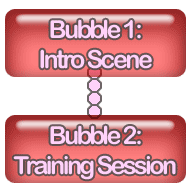
[ two crappy-looking example bubble ]
Now, you'll continue to add these bubbles, and keep adding more sections of the story, eventually ending up with a whole bunch of bubbles on sticks, with ideas inside. This can help you form a representation of all the items in your game, and when they occur. This is one method I've seen lots of times before, but doesn't work for me very well... Some people like it, so you should give it a shot, and see if it works for you.
The next method I've seen is a little bit more like my method, but a little too logical for me... basically, you want to write down each of your events, the people involved, and give each a ranking to determine when they happen, and then apply these events to a timeline. This works for some people.
Example:
1: Introduce Characters 2: Tutorial 3: Boss Fight 4a: Find Lock Pick 4b: Find Key 5: Open Door
1----2----3---4---5----
This can be good for those who are very logical thinkers, and who keep track of things through numbers, etc. I find it very hard to keep track of things this way, so my method is a little more straightforward.
My method is simple. I start with several sheets of paper, or to be able to read it later, I will probably use Word, and I start a Numbered List. I start out similar to above, with just a few words to describe each event:
Next, I open a new Word Document, and just start filling in the blanks. I'll start with a Numbered event in my first list, and fill in the details:
Now, we were talking about my method of Plot Building. For the most part, I lay it all out in my head, and then let my fingers go wild on the keyboard. I know that this method doesn't work for everyone, but for me, it ends up with me getting a lot of the story done in one go. While I may not yet know the precise ending, I sort of imagine, and act out the story in my head, like a movie...
Anyone who's seen my Design Doc will probably say that it almost reads like a storyboard, minus the pictures. And with a lot of details. Some people will find it easier to leave out most of the details until far later in the process, but for the most part, you want to find a method that works for you. Some people like to work in chapters, or sections, or scenes, and I try to break up my story that way myself, but eventually end up with a long list of events that just keep going, and going. I end up adding the chapters later on, as I re-read the finished product.
Don't struggle too much just yet with the overall plot layout, we still need to figure out how to create the plot.
Why did I talk about all this crap about bubbles, and stuff? Because I want you to start trying to come up with a method of your own on getting your plot written down, to be converted to real use later. We're going to start talking about the actual story itself now, and you need to know how to lay everything you're going to make up out. So there.
Okay, so you have a couple of Good Guys, a Villain or two, a settings, and, essentially, a world in which your Game will take place. Now what? Well, for some MMORPGs, this is it. Your done. Throw in some crazy tasks, and adventures, and a few billion different types of items, and you've got your game, and people will flock to it, and stand around all day chatting, and showing off the fact that they played for 6 months straight, at $20 a month, and have just now gotten strong enough to defeat the big bad monster, and obtain the Black Dye they used to make their shirt black. Fun.
But if you're like me, and require, rather, demand some kind of adherable story, or relish the fact that when you play the game, your actions matter, you're going to want to come up with an interesting, mysterious, and fun story for your Players to follow, and treat them to a game they can have a good time with. So the story is going to play a big part. Better not screw it up. At this point, you should know something of what your story is going to be like... some inkling of an idea, but if you don't there are some tricks that I have up my sleeve, to help you out. There are several Key Story Points that we have to discuss, in order to build our story:
We're going to discuss each of these items in turn, and hopefully go through a process of getting your story together.
The Quest First, what is the purpose of your PCs? Why do they have to do whatever you want them to do? Perhaps they have to find a secret item, or rescue someone, or anything... you should decide why their leaving home. In my RPG, Worlds , our main PC, Eta, is accidentally sucked into another world through a portal, and after an accident in the Lab where he ends up, Eta is blown to another world, and lost within the Omniverse. He's now on a Quest to find his way home. (See that? That's like pointing out the key word, that is... oooo... )
Now the Quest can (and probably will) change periodically throughout the game, as more information becomes available... but they should generally stay static through most of the major sections (only really changing occasionally). Now a quest is the overall goal of the PCs, which is what they're trying to do in a big-picture type of thinking, a path is sort of like a mini-quest, that only lasts for a short time, until the PCs get to the next Path. Try not to get them confused...
Alright, so you're having trouble Picking a quest. Well, I've got help for you! Anyone who's familiar with the D&D Dungeon Master's Guide on Building a Dungeon should know this trick. Get out your d6es (six sided dice) (or made a quick random-number generator), and roll to pick out a quest (roll for each category, and then add them together):
Type of quest:
Item/Person Involved:
Okay, so lets make some rolls....
And it looks like I got........... a 3 , and a .... 1 ... hmmm, so we consult the tables, and we get: Escape from Royalty . Well, so how do we work this in as a Quest.... let's see...
The Quest Our Main Character, who happens to be some sort of political activist, is under surveillance by the Duke of a neighboring Dukedom. The Character is suspected in a plot to overthrow the government, but he continues to state his innocence. After a failed assassination attempt on the Duke's Brother, he sends a team of warriors to take out our main character. While having a quiet evening at home one night, our PC sees a group of mercenaries snooping around his house, so he picks up his well-oiled sword, dons his ebon cloak, and steps out into the night to confront the sneaks.
Pretty neat, huh?
Came up with that on the spot... You may find that you have a little trouble coming up with a good quest right off the fly, so you may want to think it out for a while. I've kind of touched on a little bit of a path as well, at least the beginnings of one...
You may decide to come up with your own general quest generator, or just make up a quest out of your head... You'll want to try and make it a coherent path from quest-to-quest, so you may decide to do a few rolls all at once. Lets say I roll again, and I get: 5 and 2 .... Release a Town/Place ...
Okay, so our hero escapes from the Duke, but then comes back to Free the town from his tyrannical rule. It all should lock together. Remember, Quests are big events, that take a lot of time to complete, and are composed of tiny Paths .... it will all make sense soon...
The PCs' Role We're going to talk about the role that the PCs have in their quest. While this is sometimes something you want to come up with before you make up the Quest, you can usually base it off of what the Quest is, which is why I wanted to bring it up after the Quest. Generally, what is the PCs overall role in this adventure? Are they trying to save the world? Save a country? Find a particular item? Are they good guys? What? This is going to be the overall general thing that's going on in the game.
Example (continued off of the last example):
Our heroes are going to eventually go on a quest to find a secret, magical item to save the world with, and keep it from the villains.
If you look at it in sort of a hierarchy of how the story breaks down, the PCs' Role is at the top, which is made up of slightly smaller Quests , which are each made up of even smaller Paths .
You can go ahead and roll for your Role, if you want, but I would recommend looking for a bigger connection to the whole thing yourself. If you want, you can save the Rold for last, and put everything together then.
The Villians' Role Just like the aforementioned PCs' Role , the Villians' Role is what the overall goal of the Villians in your story. Make it simple. Why do they want to stop the PCs? Or what goal do they have that the PCs are interfering with?
Lets bring out our Villain again from the earlier NPC section.
The Villians are looking for the same magical item, to bring total chaos and darkness to the world. They are racing against the PCs to locate the item first.
Short and sweet is all you really need.
The Path Really, I should call this "Paths", and this is where things start getting complicated. You'll want to create several mini-obstacles for the PC to navigate through. You may want to simply make a list of simple things for them to do:
...and then expand on these:
And so on and so forth...
Anyway, just add whatever seems natural to the story. And take baby steps from point a to point b. It should be pretty simple, so don't try to over think things. (For those, like me, who think better in a narrative way, go ahead an just explain the whole story between paths, and it should work out fine.)
The Reward So what are the PCs going to get out of their Quest(s)? If they win, do they save the world? Become rich & Famous? What motivation do they have to go through with it? Come up with a logical jump from their quest, for instance, if they're on a quest to locate a magical item, then don't have the reward have something to do with the cute girl down the street....
A logical jump would be to say that once they find the item, they can use it to rid evil from the world, and live out their days in blissful peace. Sure, why not?
The Consequences
What will happen if your PCs fail? While this won't necessarily be used for an "alternate ending" type thing (though it could ), you still want to come up with some kind of threat to hold over the PCs heads, to help keep them moving. In this case, we want to say that if they don't find the magic relic before the villains, then the world will be plunged into darkness. You will most definitely refer to this consequence often throughout the game, in a manner that the player will want to try and make sure that they do what they need to do.
Using FFVII as an example, the 3rd disc, with Meteor hanging over the horizon was an ominous reminder of the consequences of failing, as well as a push to kind of get the player to keep moving. Who knew when that thing was going to land... scary...
By now, you should have everything put together, in many, many different files, and sheets of scrap paper. The last thing you need to do is Type it all up in a coherent, easy to follow document, called the Design Document .
So now we're working on putting all these things together, in order to make it easy to follow, clear, and have all the details in one place.... well, we can try, anyway....
Most game developers put all their story information into a large document called the Design Document , which should hold every last bit of information that all the people working on the project will ever need to know. As well as the Story, the Design Document will hold biographical information on all the characters, general information on the overall game, and a whole lot of information on the code, and programming of the game itself. You can read some of Marz's Tutorials to help get some of the Design Doc things out of the way, I think he's a much better tutorial writer than I am, but when you're typing up the story, you'll want to keep a few things in mind:
Try and keep the story easy to follow, make references to other parts of the document. Include illustrations of things if you need to! Just try to make it look professional, and you should be okay.
You can see my design doc (so far) at: http://seifertim.no-ip.com ... Please let me know what you think of my tutorials!!
Unless I think of anything else to add: The End.
Just a final word before we wrap up. What you've seen here is freshly baked content without added preservatives, artificial intelligence, ads, and algorithm-driven doodads. A huge thank you to all of you who buy kirupa's books, became a paid subscriber, watch the videos, and/or interact on the forums.
Your support keeps this site going!
- SeiferTim

:: Copyright KIRUPA 2026 //--