This is an archived tutorial from the kirupa.com legacy collection. It covers software that may no longer be available, but it is kept online because the ideas still hold up.
Just when you thought you had learned Flash
5, and could now devote resources to becoming a Flash
master, Flash MX comes along. Flash MX is really not a
complicated program, but there are numerous enhancements
that will take a while getting used to.
This tutorial will help you to learn the very
basics of Flash MX - basics such as layers, tweens, colors,
text, lines, shapes, and more. By the end of this tutorial,
you will have created the following animation:
[ you will create the above
animation ]
Setting Up the Movie
Before you can create your Flash
masterpiece, you have to adjust the actual movie. Not all
movies are created the same, and many movies feature varying
background colors, widths, heights, and more. The next few
steps will explain how to setup the movie for creating the
above animation:
-
Create a new document in Flash MX
by going to File | New. A new, blank Flash MX movie will be
displayed.
-
First we need to modify the
movie's properties such as background color, dimensions,
speed, and more. Click anywhere in your movie and the
Properties panel will display near the bottom of the
screen.
-
Press the Size 550x440
button in the Properties panel near the bottom-center of
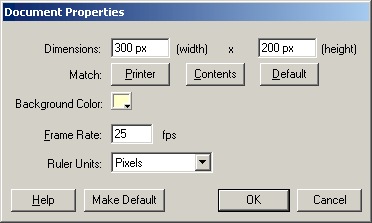
your Flash window. The Document Properties
dialog box will appear. In the width and height
text fields, enter the values 300 and 200 respectively.
-
Now, press the Background Color
square in the Document Properties dialog box. Pick a light
yellow or beige color from the list of colors visible.
-
The final step involves
changing the value for the frames per second (fps). In the
Frame Rate field, enter a value of 25.
-
Your Document Properties dialog box
should look like the following image after completing the
above steps:
[ the modified document
properties dialog box ]
-
Press OK to accept the changes you made to the Document
Properties dialog box. Your Flash movie will now reflect
the changes you made.
I recommend that you save your file now.
Saving often can help save hours of frustration when an
unforeseen error causes you to lose all of your work!
Now that the movie is set-up, let's add some
text, lines, and shapes to the stage. Click the next section
link below to go to the next section!
Before we get to animating, we need to create
the objects. An object in Flash can be anything ranging from
a line to text to a polka dot. You can convert objects into
buttons, graphics, and movie clips, but I will discuss that
later in another tutorial.
For now, the following instructions will tell
you how to add the box outline and text as seen in the
example in the previous section:
-
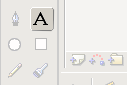
Press the Text Tool icon in
the Tools panel on your left side of the Flash MX program:
[ the text
tool icon ]
-
After pressing the Text Tool
icon, click near the center of your movie area, and drag a
rectangular shape. You will see a text field appear in the
spot where you clicked. Enter the words "Flash MX". Press
the Arrow Tool on the Tools panel after you entered the
words.
-
With the Arrow
Tool selected, you are no
longer in the Text mode. Select the Flash MX text you
entered. You will see the Properties panel displayed below.
-
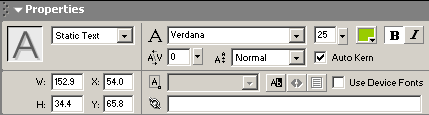
From the Properties panel for
the words "Flash MX", make the following changes:
-
Set the font to Verdana.
- Make the font size 25.
- Press the 'B' icon to make the text bold.
-
Change the color on the text to
a pale green.
Your Properties panel should look like the following
image:
[ the
properties panel from which the text was modified ]
-
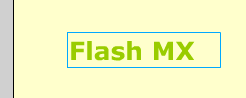
While the changes were being
made, you may have noticed that the text changes in
real-time to each change you make. Your text should look
like the following image:
[ the modified text ]
-
You have just completed creating the text. I think it is
time we animated the text don't you?
Animating
With the text created and formatted, let's animate the text.
The following instructions will explain how to animate the
'Flash MX' text you entered:
-
Select the text and drag it to your left where it is not
visible on the main working area. In other words, ensure
that the text is moved left so that no portion of the text
is visible on the beige background:
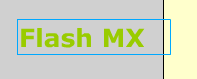
[ move the
text to your left ]
-
Go to your timeline. The timeline is the series of
vertical, rectangular boxes with numbers set in intervals
of 5. Right click on the vertical box below the 25 and
select 'Insert Keyframe':
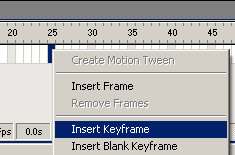
[ the insert
keyframe command ]
-
Once you select the Insert Keyframe command, you will see
a small black dot displayed in the box under 25. The box
under 25 is called a frame. From hereafter, when I refer
to Frame 25, I am referring to the box under Frame 25:
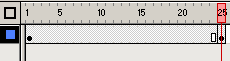
[ you should
see two keyframes: one on frame 1 and one on frame 25 ]
-
Select the keyframe on Frame 25. Note that the text on
your work area is also selected. Select the text with your
mouse cursor, and press the right arrow to move the text to
your right. I recommend you press Shift + Right Arrow to
make the text move to your right even faster. Stop once
the text has gone of the movie area on the right:
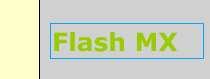
[ the text
is now on the right side of the movie ]
-
Now, we are ready to animate the text between frame 1 and
frame 25. Select the keyframe on Frame 25. Notice that the
Flash MX text is on the left of the window. Flash's job is
to seamlessly make the text transition from the left side
of the drawing area to the right side of the drawing area.
-
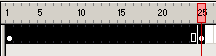
Select all the frames in your timeline by clicking on
Frame 1 and dragging all the way to Frame 25. Make sure
that you are not dragging the actual keyframe toward Frame
25. Once you have selected all the frames, your timeline
will be blackened as seen in the following image:
[ the frames
in the timeline are now selected ]
-
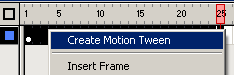
The frames should be selected. Right click on any selected
frame and choose 'Create Motion Tween':
[ create
motion tween command ]
-
Your timeline will now be shaded a purple color. Click
anywhere on the timeline, and you will notice that your
text is moving from the left to the right.
You have just animated the text in Flash
MX. Save the file now. Go to File | Publish Preview | HTML.
You will see the animation scrolling from left to right
inside your browser. Wohoo!!
We are still not done with this tutorial.
We still have to add a background and use some layers. Click
the next section link to progress through the tutorial.
In this final page out of our three page
tutorial, we will look at using layers to create some
background shapes for the animation. Before you can add a
background design, we need to learn about layers.
Layers
Flash uses layers to organize various objects in an
animation. In fact, we have been using a layer all this
time. Look at your timeline. The text that says 'Layer 1'
signifies a layer.
We will be editing and adding another layer. The following
instructions explain how to do that:
-
You should have noticed the text, Layer 1, in the
timeline. The text 'Layer 1' is just not descriptive
enough for what is actually contained on the layer: the
Flash MX text.
-
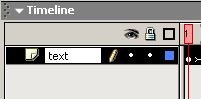
Double click on the Layer 1 text to the left of the
timeline. You will notice that the text is now selectable.
Enter the word "text" to replace Layer 1":
[ renaming
the layer to make it more descriptive ]
-
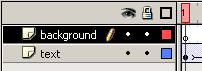
Now, let us add another layer to house the background.
Right click on the 'text'
layer and select Insert Layer. You will notice a layer
labeled "Layer 2" is displayed above your text layer.
Rename that layer background by double clicking on
the Layer 2 text. The left side of your timeline should
look like the following image:
[ another
layer has been added ]
-
Notice that the background is
above your text layer. Layers are like floors in a
building. The furniture in the top floor is above the
furniture in the bottom floor. Similarly, the contents of
the top layer will go above the contents in a bottom layer.
Because we want to create a background, the content in the
background layer should be displayed below the text layer.
Click on the background layer and drag it below the text
layer. Your timeline should look as follows:
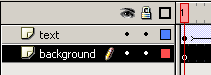
[ the
background layer has been moved down]
As mentioned previously, the
background layer has been moved below the text layer. If the
background layer was above the text layer, the text will be
hidden from view by the background (after you add one).
Adding a Background
Let's add a background to make the animation look cooler.
The following instructions will guide you in adding a
background design:
-
Select the first empty keyframe of the background
layer. You will notice that the empty keyframe is
selected. Everything you add to your animation will now be
on the background layer because you just selected it by
clicking the empty keyframe.
-
Select the Oval Tool (the circle) from the Tools panel.
You will notice that your properties window reflects the
circle properties such as line color, fill color, and
more.
-
Click the color box for the line (Stroke) of the circle
from the Properties menu. Select the no color option from
the top-right of the menu. The no-color option is the box
with a red line through it:
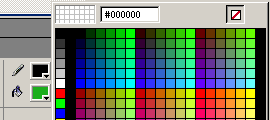
[ the
no color option for the line]
-
After you select the no-color option for the outline of
the circle, click the fill icon on the Properties panel.
From the color menu that appears, select a white fill
color. Your Properties panel should look like the
following image:

[ the
property panel for the circle ]
-
Now, it is time for you to draw circles for the background
of your animation. Click anywhere in your movie and drag.
You will notice a circle in the size and shape of your
dragging is created. Release the mouse to set the circle
in place.
-
Repeat the above step (step v.) until you have numerous
randomly sized circles dotting your movie. The following
image shows how I arranged my circles:
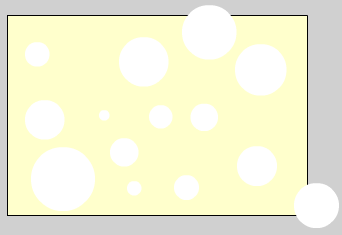
[ how I
arranged the circles in my animation ]
-
Save this file and go to File | Publish Preview | HTML.
You will now see your animation with the text 'Flash MX'
going over the circles.
You have just completed creating a basic
animation in Flash MX. By completing this tutorial, you were
introduced to various topics such as formatting text,
layers, animating (tweening), shapes, and more!
Like I always do, I have provided you with
the actual Flash file that I used to write this tutorial.
Click the link below to download the file and to see how my
animation looks:
Just a final word before we wrap up. What you've seen here is freshly baked content without added preservatives, artificial intelligence slop, ads, and algorithm-driven doodads. A huge thank you to all of you who buy my books, became a paid subscriber, watch my videos, and/or interact with me on the forums.
Your support keeps this site going! 😇

 Tutorials
Books
Videos
Forums
Tutorials
Books
Videos
Forums


