This is an archived tutorial from the kirupa.com legacy collection. It covers software that may no longer be available, but it is kept online because the ideas still hold up.
Here's a very basic tutorial for using
Swift3d v.2 with Flash. This is the tutorial I wish I had,
and I simply could not find anywhere. Hope it helps you
build some neat effects. This tutorial assumes a very basic
working knowledge of Swift and Flash. I will be using
FlashMX, but the concepts are the same for Flash5.
Let's Get Started!
Roll over the animation below. This is what we're shooting
for.. pretty cool for your first one!
[ rollover
the above animation to see a cool effect ]
First, we will create our animation in
Swift3d v.2.
-
Open Swift 3D
-
Click on Create Sphere. This
will create a sphere (yeah, that's right!) with a radius of
0.500, longitude 16, latitude 16.

[ the create
sphere button ]
-
Hold Right-Click and drag down
in the Front-Active view so you can zoom out and see
more of the workspace.
- Click on Create Torus. You wont
see anything on your view yet because the Torus is too small
and in the wrong position right now. Let's fix it!

[ the create
torus button ]
-
Change Minor Radius to
0.600, and change Major Radius to 0.800:
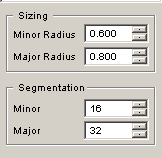
You can
do this by typing in the values in the box, or using the
interface to the right of the box that holds the
values. (they look like tiny triangles. One increases value,
one decreases value)
Let's add some color.
-
Click on the Glossy Colors
tab to select it.
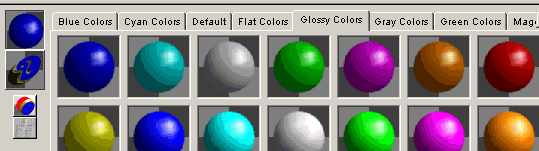
[ the colors
you can select under the glossy color tab ]
-
Select the color value of your
choice (I chose Blue). Click and Drag the color on to the
"ring" (the Torus shape).
-
Add color to the sphere
the same way you did in step 7. Save your work
This is a good stopping point, because it
will give us a chance to save our work so far and export it
as an illustrator file. This is just the format I prefer to
use. This file will provide the "up" state for your button.
"Up-state" is the way the button looks when users hit
your page for the first time.
-
Select the Preview and Export
Editor tab:
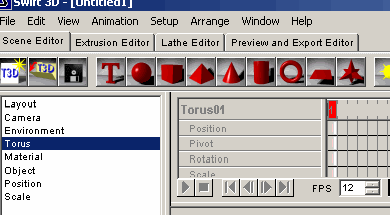
[ the
preview and export editor tab on the top-right ]
-
In the "Output Options"
section, select General. Under Target Type, choose Adobe
Illustrator (AI):
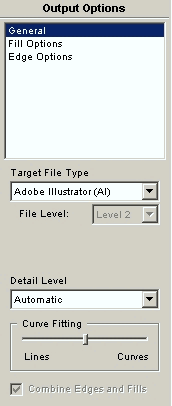
[
customizing the output options ]
-
Click on "Fill Options"
and select Cartoon Full Color Fill.
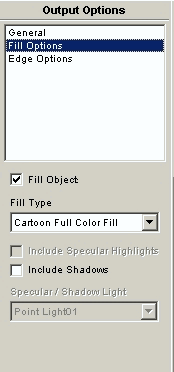
[ modifying
fill options ]
-
In the Render Preview Area,
click on Generate Current Frame. WooHoo! No big
deal.. but we need this piece. We will import into Flash
later.
-
In the Export To File area,
click on Export Current
Frame...
-
Give your file a name and click
on Save. I called my file Hoop.ai.
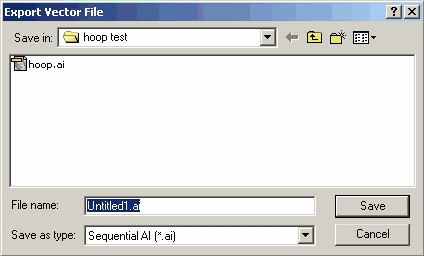
[ the export
vector file dialog box ]
Take a quick break, relax!
Click the next section link to view the next section of the
tutorial:
Piece of cake, so far! Now, let's create a quick animation
sequence. First, let's go back to our working area in Swift
3D.
-
Click on the Scene Editor
tab.
-
If it's not already selected,
Select the Torus on the Scene. At this point, we want to
flip the ring down. In order to do this properly (for the
animation in this tutorial), we need to change the pivot
point of the Torus.
-
Click on the Animate button at
the top right of your screen.
[ the
animating button ]
-
Click the number 20 in the
timeline.
-
In the left panel. Click to
select Position.
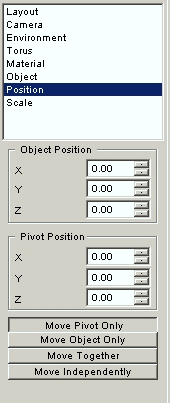
[ adjusting
the position ]
-
Go to the button section below
and
Click to select the Move Pivot Only (see image
above). This will allow us to move the red and green
crosshairs to the location we want without disturbing the
object. This is slightly similar to the registration point
in Flash.
-
Position the Pivot point on
the bottom edge of the Torus.
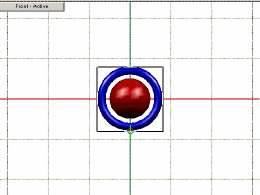
[ arranging
the objects in our 3d space ]
-
As soon as you do that, the
lower left panel which controls object rotation will show
you the object in relation to it's pivot point. Click on
Lock Vertical.

[ the lock
on vertical tab enables you to shift your object vertically
]
-
With the vertical axis locked,
use the globe in the lower left panel to drag down. You
want to drag down far enough so you can see through the
Torus. Whew! Gotta love it! Your screen should look
similar to the next illustration:
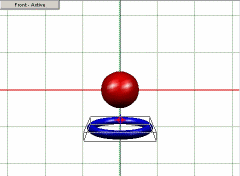
[ the torus
after it has shifted in its axis ]
-
Click on the Play button
underneath the timeline. Pretty cool, and easy as pie.
-
That will complete our rollover(mouseover) effect. Let's save and export it to
Flash. You're almost done!
-
Click on File. Click
on Save.
-
Click on the Preview and
Export Editor tab.
-
In the Output Options section,
click on General. Now, click to the right of Adobe
Illustrator, and make your Target File Type to be Flash
Player(swf).
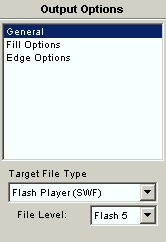
[ the output
options panel ]
-
Click on Generate Entire
Animation. (The render engine for Swift is killer fast!
However, rendering speeds vary depending on the speed of
your system. Mine took about 9 seconds.)
-
Click on
Export Entire Animation...
-
Give it a file name (I called
it Hoop.swf), and click Save. Exit Swift.
On to Flash to finish this puppy!
-
Open a new file in Flash. Movie
Size should accommodate your image. Mine is set at the
default 550x400 with a white background and 12 fps. Yours
will look different than the one below if you're using Flash
5.
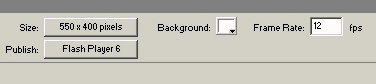
[ modify the
movie properties ]
-
In your menu (above) click on
Insert. Click on New Symbol. Select
Movie Clip and click OK.
-
Click on File. Click
on Import and select hoop.swf and click
Open. Voila! We have our movie. Click on
Scene1 to return to the scene.
[ the scene1
tab ]
-
Click on File. Click
on Import.
-
Select the hoop.ai file and
then Click OPEN. Click OK. If you don't see
your drawing, try scrolling up. Sometimes Flash puts the
imported image off the screen. If the image is off the
screen, select the image and bring it down to your scene.
-
With the drawing still
selected,
use the F8 key on your keyboard, or click
on Insert, Convert to Symbol.
-
In the Behavior Section, choose
Graphic. We do this because we don't need all the paths
from Illustrator, we just want a straight image. Click OK.
-
With your graphic selected, Hit F8
again. This time, we will convert our newly converted
graphic to a button. Select Button from the Convert
to Symbol panel and click OK.
-
Double click on the button you
just created (your graphic is now a button) to edit your
button.
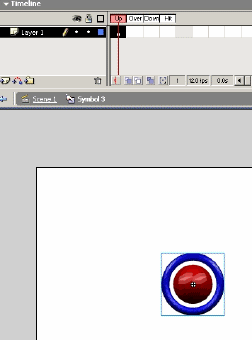
[ the button
in Flash MX ]
-
Click on the onion skin button. Onion skin
will help us with placement.

-
Right click on the white space
underneath the Over area in the button timeline.
 Select Insert Blank Keyframe.
Okay.. when will this thing be over? Well,
in about 4 steps. Here we go.
-
Hit F11 on your keyboard. This
will bring up the library.
-
Select the movie clip (looks
like a cogwheel)...

...and drag onto the scene. You should place the movie
clip so that it is EXACTLY over the onion skin graphic.
-
Turn off Onion Skin by
clicking on the same button you clicked on in step
-
Click on Scene1.
[ the scene
1 tab ]
-
Drum Roll.... Click on Control.
Click on Test Movie.
Whew! Wasn't that fun! Swift is not the
best for modeling, but it will do great with simple stuff
like this.
Hope you enjoyed the tutorial. If you have
any questions or comments, please drop me a note or post on
the forums.
created by.. Montoya.
"My name is Indigo Montoya. You killed my
father.. prepare to die.."
[email protected]
Just a final word before we wrap up. What you've seen here is freshly baked content without added preservatives, artificial intelligence, ads, and algorithm-driven doodads. A huge thank you to all of you who buy kirupa's books, became a paid subscriber, watch the videos, and/or interact on the forums.
Your support keeps this site going! 😇
 Tutorials
Books
Videos
Forums
Tutorials
Books
Videos
Forums




