 Tutorials
Books
Videos
Forums
Tutorials
Books
Videos
Forums


This is an archived tutorial from the kirupa.com legacy collection. It covers software that may no longer be available, but it is kept online because the ideas still hold up.
Because Swift 3D is a three-dimensional vector editing/creating program, you can create and edit objects in all three dimensions (x, y, z). Because it is difficult to visualize a three dimensional plane on a 2D monitor, Swift provides you with different camera angles for you to work in. Learning to use the camera angles to your benefit will make you a better "swifter" in the end!
This tutorial will help you to grasp positioning objects in a three-dimensional space in Swift 3D. The final source and a sample animation that I created combining Swift 3D and Flash will be provided towards the end of this tutorial!
Problem: I want to create the illusion of looking through a series of rings using Swift 3D.
Here's the Solution:

[ the show secondary camera
button ]

[ create torus button ]
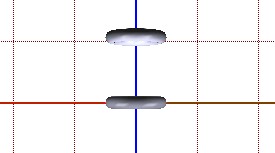
[ the top panel ]
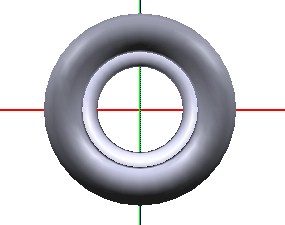
[ you see two torus'es' ]
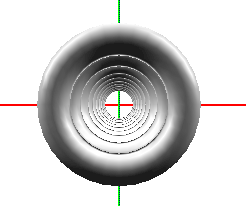
[ note: I colored all the toruses to a lighter shade of gray ]
Camera Angles
I'm writing this in the hope that I do
not confuse you any further :-) The Front and Top panels in
Swift are nothing more than camera panels. Imagine that
there are two video cameras taping your every movement. One
camera is directly in front of you while another camera is
directly above you. You see the images from both cameras on
your computer.
As you move backward, you notice that in the Top panel, the top of your head seems to move backward - while in the Front panel you seem to get smaller as you move away from the camera. The equal but different motion you see of yourself is the same way Swift works.
That is the best way for me to explain how the camera angles work in Swift. For every movement you make in one camera panel, an equal change occurs in another camera panel. The camera panels fulfill their goal in making it easier to place and arrange objects in a 3D plane. It is very difficult to place an object behind by using only the Front panel, but if you use the Top panel, you can place objects easily on a horizontal plane.
The following is a sample animation I created using the technique discussed in this tutorial. Instead of using a torus shape, I used rectangles for a smaller file size:
Being the kind, benevolent guy that I am, I have provided the source files for the above animation and tutorial. Click on the following links to download:
 |
Sample Animation |
 |
Rectangular Blocks in Sample Animation |
|
|
Torus Sample (Tutorial Source) |
With the download links mentioned above, this tutorial comes to a close. I have not explained how to create the animation featured in the tutorial, but the animation does show how organizing objects in a three dimensional space is useful.
Just a final word before we wrap up. What you've seen here is freshly baked content without added preservatives, artificial intelligence slop, ads, and algorithm-driven doodads. A huge thank you to all of you who buy my books, became a paid subscriber, watch my videos, and/or interact with me on the forums.
Your support keeps this site going! 😇


:: Copyright KIRUPA 2026 //--